Why China, and Why This Guide Exists
If you are sourcing PDLC smart film in any serious volume, you will eventually end up looking at China. That is not a coincidence. The country produces the overwhelming majority of the world's ITO-coated PET film, the foundational material that PDLC technology is built on, and the supply chain for liquid crystals, polymer emulsions, and precision coating equipment is concentrated in a handful of industrial clusters, mostly in Shandong, Jiangsu, and Guangdong. For buyers, this means competitive pricing and short lead times. It also means a market crowded with companies that call themselves manufacturers but are anything but.
Over the past decade at AYSENT, we have watched this market mature from a handful of specialist producers to a fragmented landscape of factories, trading houses, and re-sellers all competing for the same international buyers. We regularly talk to distributors and contractors who have been burned — by film that delaminates after six months, by suppliers who vanish after the first order, by "factories" that turn out to be a desk in a shared office. This guide is the conversation we have with every new wholesale client, written down. It is the checklist we would want if we were buying from someone else.
The First Distinction: Factory or Trading Company
This is the single most important question you can ask, and it is also the one most suppliers will lie about. A genuine PDLC manufacturer runs a coating line. That means they own the equipment that applies the liquid crystal emulsion to the ITO film, cures it, and laminates the final product. A trading company buys finished rolls from one of these factories and marks them up. Sometimes they do a decent job of quality control. Often they do not.
How do you tell the difference? Start with the basics. Ask for factory photos and videos, but understand that these are easy to fake — anyone can walk into a factory they do not own and film it. Better questions:
- What is the maximum width you can coat in a single pass? A real factory will know this number down to the millimeter. A trading company will hesitate or give you a round number they found on a website.
- Can you show me your coating line running? Ask for a video that includes the date and a handwritten sign with your company name. This is surprisingly effective at filtering out re-sellers.
- What is your monthly output? Real factories have a number. Trading companies do not, because they do not control production.
- Who is your ITO film supplier? Manufacturers buy this material directly and will tell you. Trading companies often do not know.
If you are placing an order above a few thousand square meters, a factory visit is non-negotiable. Most legitimate manufacturers, AYSENT included, will cover your travel or at least arrange pickup from the nearest airport. If a supplier actively discourages a visit, that is your answer.
The Sample Test: What to Actually Measure
Every supplier will send you free samples. That is the easy part. The hard part is knowing what to do with them when they arrive. A two-inch swatch taped to a piece of glass tells you almost nothing. Here is what we recommend.
First, test the switching speed and the quality of both states. In the ON (transparent) state (learn how PDLC switching works), hold the sample up to a bright window. Cheap film has a persistent haze that looks like smudged glass even when fully powered. Quality film should be clear enough that you forget it is there. In the OFF (frosted) state, check for uniformity. The opacity should be even across the entire panel, with no brighter spots or visible patterns. If you can see shapes through the frosted state, the liquid crystal droplet size is wrong — a common sign of rushed production.
Second, measure the voltage and power draw. Most PDLC film runs between 48V and 65V AC. If a supplier tells you their film runs on 12V DC, be skeptical — that is usually a sign of a different, lower-performance technology. Power consumption in the ON state should be around 4 to 6 watts per square meter. Much higher than that and you are looking at an older formulation.
Third, do an adhesion test if you are evaluating self-adhesive film. Apply a sample to a clean glass pane, wait 72 hours, and then try to peel it off at a 180-degree angle. Good adhesive leaves residue and resists peeling. Bad adhesive comes off in one sheet.
Finally, and this is the one most buyers skip, run a thermal cycle test if you have the equipment. Put the sample in an oven at 60 degrees Celsius for 72 hours, then freeze it at minus 20 degrees for another 72. Let it come back to room temperature and check for delamination, bubbling, or color shift. Film that survives this will survive real-world installation in the Middle East or Northern Europe. Film that does not will fail within two years.
Certifications That Matter, and Ones That Do Not
You will see a lot of certificates on Chinese supplier websites. Most of them are real but meaningless — industry association memberships, "high-tech enterprise" awards, quality management certificates that any company can buy. The ones that actually tell you something are:
FCC certification for the control system and the film's electromagnetic emissions. This is required for the US market and surprisingly difficult to fake because the test report includes a lab name and report number you can verify.
CE marking for the European market. Be aware that CE self-certification is common in China, so ask for the notified body number if it is a product that requires third-party testing.
RoHS compliance for restricted substances. Relevant if you are selling into the EU or California.
Test reports from independent labs for optical performance — haze, visible light transmittance, UV blocking. SGS, TUV, or Intertek reports carry weight. In-house test reports do not.
If a supplier cannot produce an FCC report with a verifiable lab number, walk away. It is not worth the risk of having a shipment seized at customs.
Capacity, Width, and What "Custom" Actually Means
PDLC film is sold in rolls, and the maximum width of those rolls is a real constraint that varies significantly between manufacturers. Standard widths in the industry run from 1.0 meter up to 1.8 meters. At AYSENT we produce up to 2.1 meters in a single pass, which is at the upper end of what is commercially available.
Why does width matter? Because every seam in a finished glass panel is a potential defect point and a visual distraction. If you are supplying 1.5-meter-wide office partitions and your supplier only makes 1.2-meter-wide film, every panel gets a seam. That is not a problem for the supplier — it is a problem for your reputation.
Ask specifically: what is the maximum continuous width, and what is the tolerance on thickness? A good manufacturer holds thickness tolerance to plus or minus 5 microns. Anything wider than that and you will see visible differences in opacity across a large installation.
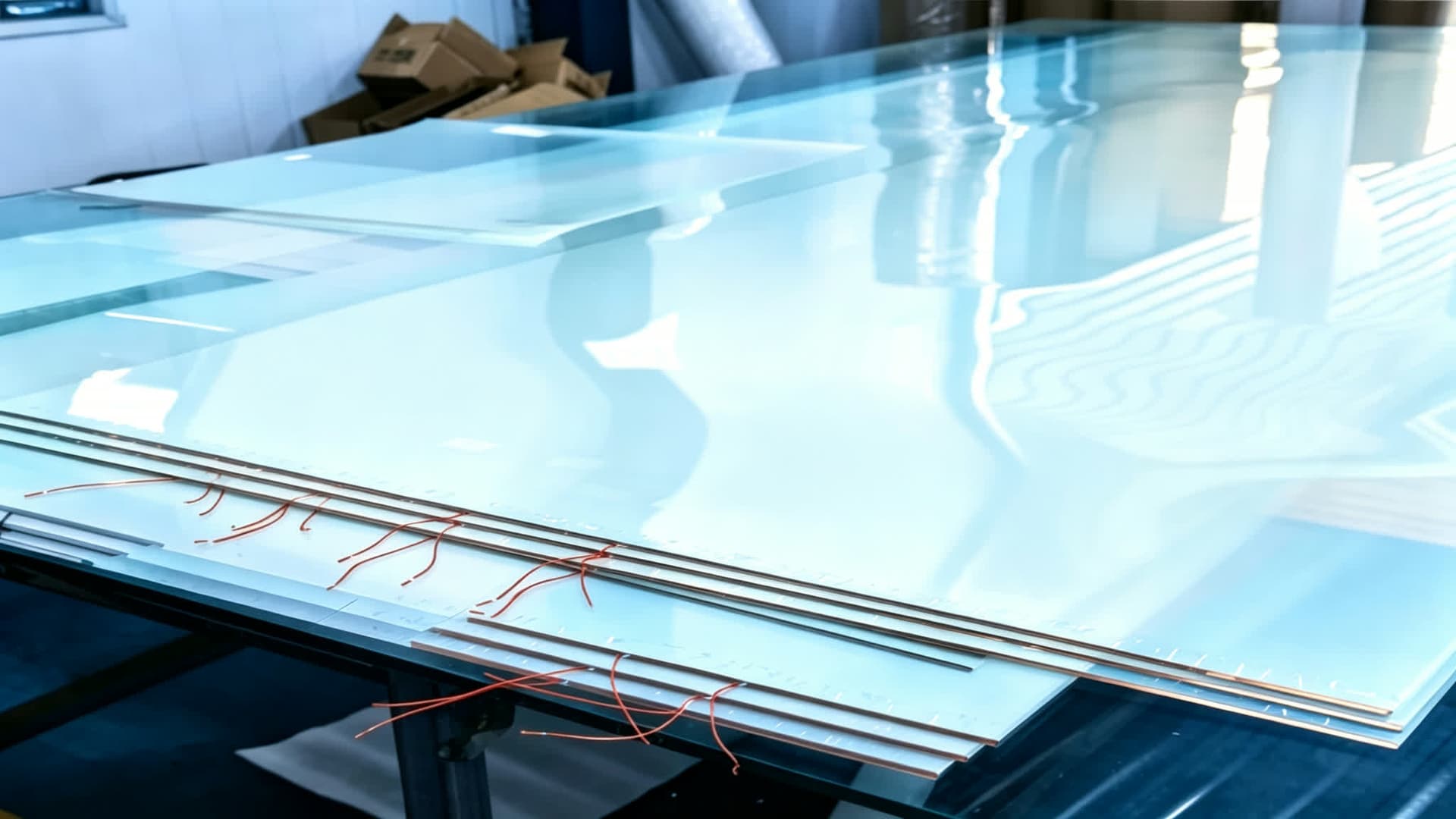
Custom cutting is standard — every manufacturer will cut rolls to your specified lengths. What is less common is custom shape cutting, cutouts for handles or hinges, and pre-applied bus bars for electrical connection. If your project needs these, ask early. Not every factory has the CNC cutting equipment or the clean-room space for bus bar application.
Quality Control: Ask for the Process, Not the Promise
Every supplier will tell you they have "strict quality control." Fewer can describe it. Here is what a real QC process looks like for PDLC film:
Raw materials are tested before they go into production. ITO film is checked for sheet resistance uniformity. Liquid crystal emulsion is tested for droplet size distribution.
In-process monitoring runs continuously during coating. Thickness is measured every few meters. Switching performance is sampled at the beginning, middle, and end of every roll.
Finished rolls undergo a full electrical test — every meter of film is powered on and checked for dead spots, uneven switching, or visual defects. This is labor-intensive and some factories skip it on bulk orders. Ask whether 100% electrical testing is standard or an extra-cost option.
Aging tests are run on samples from every batch. At AYSENT we run 1,000-hour continuous switching cycles, which is roughly equivalent to three years of normal office use. If a manufacturer cannot tell you their aging test protocol, they probably do not have one.
The right question to ask is not "do you have quality control?" but "can you walk me through what happens to a roll from raw material to shipping?" The answer will tell you more than any certificate.
Pricing: What Is Actually Included
PDLC film pricing is usually quoted per square meter, and the range is wider than you might expect — from under $20 per square meter for low-end product to $80 or more for premium, wide-format film with full certification. When comparing quotes, make sure you are comparing the same thing.
Check whether the price includes:
- The control system and transformer, or is that quoted separately
- Bus bar application and lead wires
- Custom cutting to your dimensions
- Export packaging (wooden crates, moisture barrier)
- Shipping terms (FOB, CIF, DDP)
A low per-square-meter price can evaporate quickly when you add $15 per square meter for controls and another $8 for custom cutting. Always ask for a landed cost per square meter including everything.
Payment terms are another signal. New suppliers typically ask for 30% deposit and 70% before shipment. That is normal. Suppliers who demand 100% upfront are either new to exporting or worried you will reject the goods — both red flags. Established manufacturers will offer letter of credit terms for large orders, and some will offer open account terms after you have built a track record.
The Red Flags You Should Never Ignore
After years of talking to buyers who came to us after a bad experience, certain patterns come up repeatedly. If you see any of these, move on:
The price is 30% below everyone else. PDLC film is a commodity material with well-understood input costs. A price that far below market means corners are being cut, usually on liquid crystal quality or ITO film thickness.
They cannot provide a single reference customer in your country. Any manufacturer with real export experience will have clients they can name. If every reference is in Africa or Southeast Asia and you are selling in Europe, that tells you something about their quality level.
Communication breaks down after the deposit is paid. This is the most common complaint. If a supplier is fast to answer before you pay and slow afterward, you are dealing with a trading company that has no direct line to production.
They refuse to send more than one sample. Real manufacturers send as many samples as you need. Trading companies ration them because each sample costs them money.
The website shows photos of products they do not actually make. Reverse image search the product photos on a supplier's site. If they appear on a dozen other Chinese supplier sites, you are looking at a trading company using stock images.
A Recommended Sourcing Process
If you are starting from scratch, here is a process that works:
Final Thoughts
Sourcing PDLC film from China is not particularly complicated, but it does require diligence. The difference between a good supplier and a bad one is not visible in a product photo or a price list. It shows up in the uniformity of the frosted state, in the adhesion after a summer in Dubai, in the response time when something goes wrong on an installation site.
At AYSENT, we built our factory because we believed international buyers deserved a manufacturer that would answer technical questions honestly, test every batch, and stand behind the product with a real warranty. We are not the cheapest option on the market, and we will never claim to be. What we offer is consistency — batch after batch, project after project, in fifty-plus countries.
If you are evaluating suppliers and want a second opinion on a quote or a sample, reach out. We are happy to look at what you have been offered and tell you whether it measures up. Even if you never buy from us, we would rather you get good film from someone than bad film from anyone. That is how this industry grows.
Frequently Asked Questions
Why are most PDLC films made in China?
How do I distinguish a factory from a trading company?
What tests should I run on PDLC film samples?
What is the typical MOQ for Chinese PDLC manufacturers?
How do I handle quality issues with a Chinese supplier?
Ready for Your Project?
Get free samples and a custom quote from AYSENT, your trusted PDLC smart film manufacturer.
Request a Free Quote