What Is PDLC Smart Film? How Switchable Film Works
If you have ever watched a glass wall go from crystal clear to frosted white at the touch of a button, you have seen PDLC smart film in action. Behind that everyday moment is a surprisingly clever piece of materials science that has quietly become one of the most versatile products in architectural glass.
PDLC stands for Polymer Dispersed Liquid Crystal. At its core, it is a thin multi-layer film that looks like a transparent sticker when powered, and like a sheet of frosted glass when not. Architects, contractors, and facility managers use it to turn ordinary glass into on-demand privacy surfaces without pulling down walls or installing curtains.
The Science Behind the Switch
To understand what makes PDLC work, you need to picture what is inside the film. There are two clear plastic sheets coated on the inside with a thin layer of ITO, or Indium Tin Oxide. ITO is transparent but electrically conductive, which means it can carry a voltage across the entire surface of the film without you seeing any wires.
Sandwiched between those two ITO layers is a layer of liquid crystal droplets suspended in a solid polymer matrix. Think of it like millions of tiny liquid-crystal capsules locked in a plastic honeycomb.
When the power is off, the liquid crystal molecules inside each droplet point in random directions. Light passing through the film bounces off these scattered molecules and does not come through in a straight line. That is why you see a milky, frosted surface.
When you apply voltage across the ITO layers, the electric field causes every liquid crystal molecule to align parallel to the field. Light now passes straight through without scattering, and the film becomes optically clear. The whole transition takes less than half a second.
What You Actually See: Two Distinct States
People sometimes describe PDLC as "tintable glass," but that is misleading. PDLC does not gradually darken like electrochromic film. It has two defined states, and the jump between them is what makes it useful.
In the ON state, good PDLC film has a light transmission above 88 percent and haze below 2 percent. Through a quality panel, you should be able to read printed text on the other side from a normal viewing distance. If the ON state looks cloudy or washed out, the film is either old, low quality, or not receiving enough voltage.
In the OFF state, the film reaches a light transmission of around 60 to 70 percent but with near-zero visual clarity. You can tell that someone is on the other side, but you cannot make out faces, read screens, or follow body language. This is the privacy state, and it is what most buyers actually care about.
The Layer Structure
A cross-section of PDLC film reveals five distinct layers, each with a specific job:
For self-adhesive versions, an additional pressure-sensitive adhesive layer is applied to one side, allowing the film to bond directly to existing glass.
The Two Formats: Self-Adhesive vs Laminated
PDLC film reaches the market in two physical formats, and they are used differently.
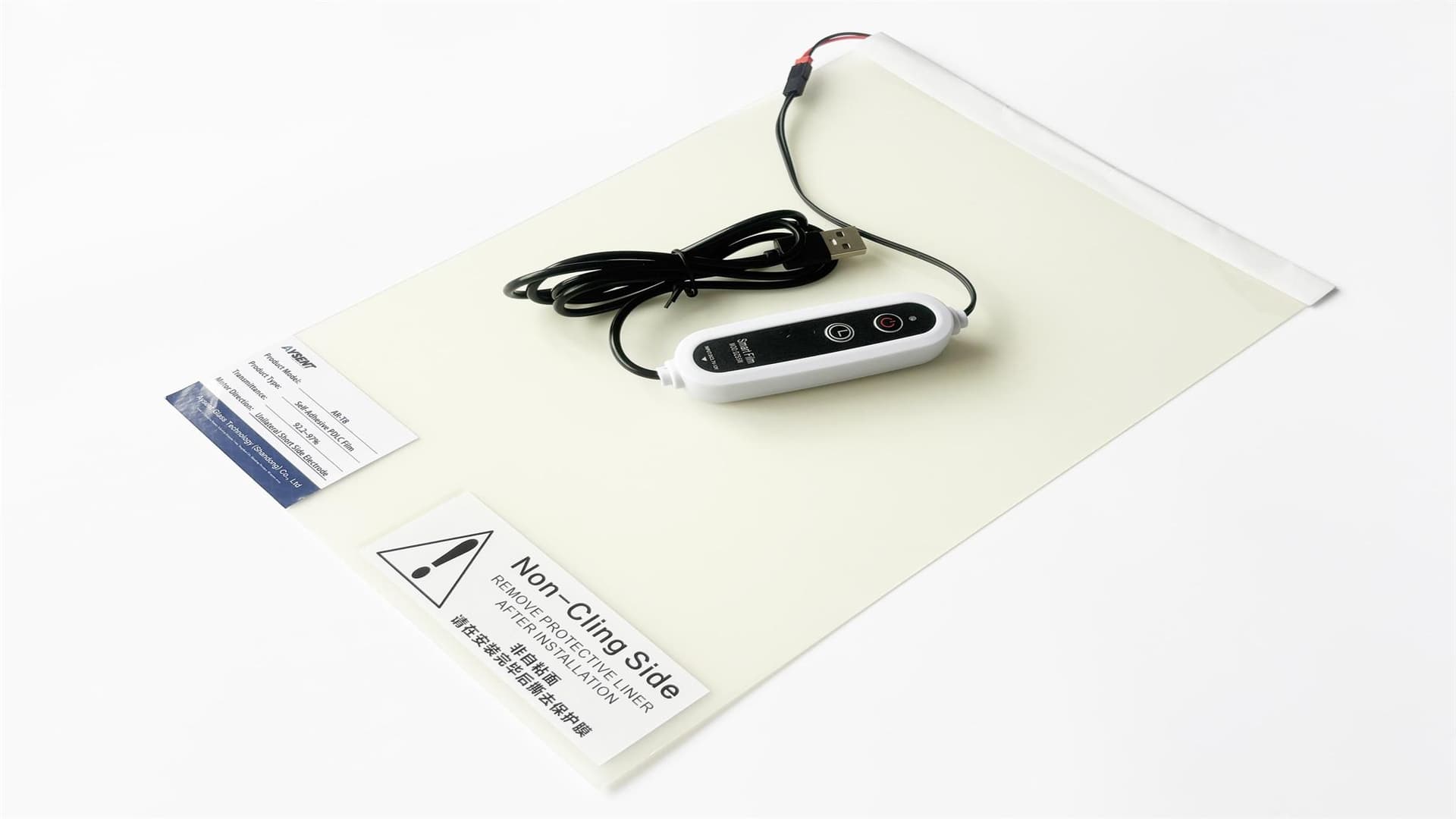
Self-adhesive PDLC film has a pressure-sensitive adhesive on one side. You peel off the backing and apply it directly to existing glass, much like a large window decal. This is the retrofit format. It is faster to install and ideal for offices, hotels, and residential projects where the glass is already in place.
Laminated smart glass is what you get when the PDLC film is sandwiched between two sheets of glass during manufacturing, with a PVB or EVA interlayer. The result is a finished glass panel that comes pre-fabricated from the factory. It is more durable, better for exterior applications, and required when the glass must meet safety or hurricane codes.
Both formats use the same PDLC chemistry. The difference is how the film reaches the glass. For a detailed breakdown of which format fits your project, see our PDLC Film vs Smart Glass comparison.
Real-World Performance Parameters
When you compare films, ask for the actual specifications rather than marketing language. A quality product will provide:
- Light transmission (ON): 88 to 90 percent
- Haze (ON): under 2 percent
- Opacity (OFF): 95 percent+ light block with zero visual clarity
- Operating voltage: 48 to 65 volts AC
- Power draw (ON): 4 to 6 watts per square meter
- Switching speed: under 0.5 seconds
- Operating temperature: minus 20 to plus 60 degrees Celsius
- Rated lifespan: over 50,000 hours of continuous switching
These numbers matter because the gap between a good film and a cheap one shows up here, not in the product photo.
Material Degradation and Failure Modes
Understanding how PDLC film fails helps you evaluate quality. The most common degradation mechanisms include:
- Liquid crystal leakage — Poor edge sealing allows liquid crystals to migrate out, causing visible edge fading
- ITO layer cracking — Flexing or impact can crack the conductive layer, creating dead zones that do not switch
- Adhesive failure — In self-adhesive film, poor surface prep or moisture causes bubbling and delamination
- UV yellowing — Low-quality PET substrates yellow over time with UV exposure, reducing ON-state clarity
- Bus bar oxidation — Poorly sealed bus bar connections oxidize, increasing resistance and causing uneven switching
Quality films address these through edge sealing, UV-stabilized PET, and corrosion-resistant bus bar materials.
Where PDLC Film Is Used
The most common installations fall into a few categories. Office meeting rooms use PDLC film to toggle between an open, collaborative layout and a private, confidential one. Hotel bathrooms and shower glass use it so guests can enjoy a bright, open room or total privacy without drawing a curtain. Healthcare rooms use it for patient privacy during exams. Retail stores use the frosted state as a projection screen for product videos.
The technology is also showing up in elevator cabs, museum display cases, yacht partitions, and even residential smart homes integrated with automation systems.
Why the Technology Matters
PDLC film is not a novelty product for showrooms anymore. It is a practical building material that solves a specific problem: how to let architects keep glass as a design surface while giving occupants on-demand privacy. As a PDLC film producer with over a decade of coating experience, AYSENT supplies both self-adhesive film and laminated smart glass to projects in 50-plus countries. Whether you are retrofitting an existing office or specifying new construction, understanding what PDLC is and how it performs is the first step to getting the right product. If you are planning a retrofit, our step-by-step installation guide walks through the full process.
Frequently Asked Questions
What is PDLC smart film?
How does PDLC film switch between transparent and opaque?
Can PDLC film be applied to existing glass?
What is the lifespan of PDLC smart film?
Is PDLC film energy efficient?
Ready for Your Project?
Get free samples and a custom quote from AYSENT, your trusted PDLC smart film manufacturer.
Request a Free Quote