The Technology Hiding in Plain Sight
Walk into any modern office building built in the last five years and you will likely see it — glass walls that go from clear to frosted the moment someone flips a switch. Most people never stop to wonder how it actually works. The answer is PDLC, and once you understand what is happening at the molecular level, the whole thing feels a lot less like magic and a lot more like clever engineering.
PDLC stands for Polymer Dispersed Liquid Crystal. It is the same family of materials that drives your TV screen and your smartphone display, repurposed into a thin, flexible film that can be applied directly to glass. For a practical introduction to the product formats and how they are used, see our what is PDLC smart film guide. At AYSENT, we have been manufacturing this material for over a decade, and the technology has matured significantly in that time. What was once a novelty product for high-end residential projects is now a standard specification in commercial buildings across fifty-plus countries.
What Is Actually Happening Inside the Film
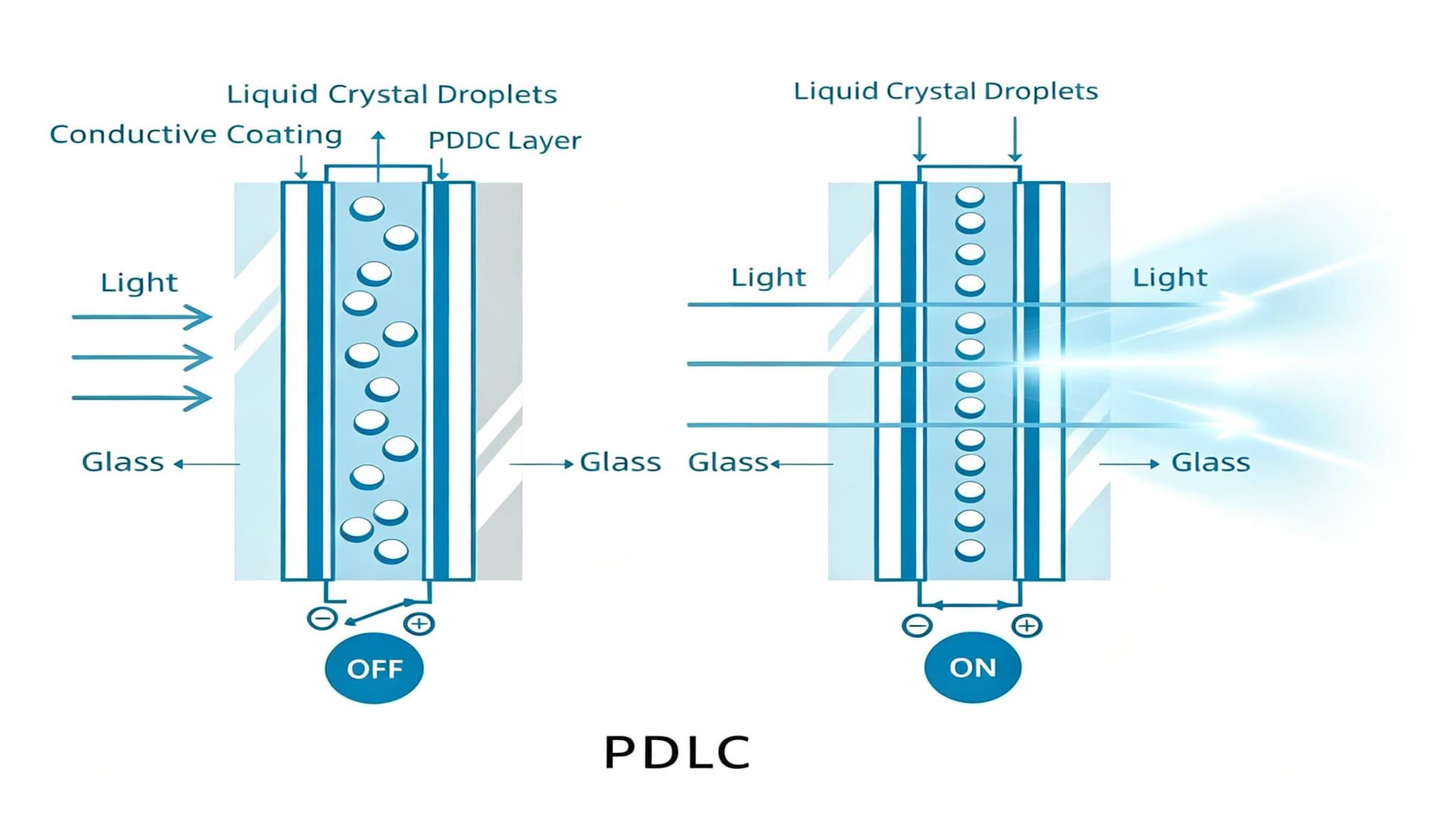
If you could peel apart a PDLC film and look at its cross-section under a microscope, you would see a remarkably simple structure. At the center sits a polymer matrix — think of it as a thin, transparent sponge — and filling every tiny pore of that sponge are microscopic liquid crystal droplets. Each droplet is barely a few microns across, far too small to see with the naked eye.
This entire liquid crystal layer is sandwiched between two sheets of PET film coated with ITO, or Indium Tin Oxide. ITO is transparent but electrically conductive, which means it can carry a voltage across the entire surface of the film without you seeing any wires. The whole stack is then protected by additional barrier layers and, in the case of self-adhesive products, a pressure-sensitive adhesive on one side.
Here is where it gets interesting. Liquid crystals are strange materials. They flow like a liquid but their molecules are shaped like tiny rods, and those rods naturally want to point in the same direction — unless something disrupts them. In a PDLC film, the polymer matrix does exactly that. When no voltage is applied, the liquid crystal droplets are trapped in random orientations. Light hitting the film scatters in every direction as it passes through these misaligned droplets, and what you see from the outside is a uniform milky-white opacity. No shapes, no shadows, just privacy.
Apply a small AC voltage — typically somewhere between 24V and 65V depending on the product — and everything changes. The electric field pulls all those liquid crystal rods into alignment. Suddenly light passes straight through without scattering, and the film becomes clear enough that you would barely know it is there. The switching happens in roughly 100 to 300 milliseconds. Fast enough that it feels instant, slow enough that the transition has a satisfying, deliberate quality to it.
The Electrical Side of Things
One question we get asked constantly is whether PDLC film uses a lot of power. The short answer is no. A standard square meter of film consumes roughly 5 watts when switched on — about the same as a small LED indicator light. Over the course of a year, a typical office installation might add fifteen to twenty dollars to the electricity bill. That is negligible by any measure.
What is less obvious is that the film only draws power in the transparent state. In the frosted, or OFF state, it consumes nothing. This is the opposite of what most people assume, and it has real implications for how you design with the material. If privacy is the default mode for a given space — a hospital exam room, for instance — the film can sit in its zero-power frosted state indefinitely, only drawing current when someone needs to see through.
The voltage itself is low-voltage AC, which means it is safe to touch and simple to wire. Control systems range from basic wall switches and key fobs to WiFi-connected controllers that integrate with Alexa, Google Home, or building management systems running KNX or Modbus. For larger installations, a single controller can manage multiple zones, and we have seen projects where several hundred square meters of film are all managed from one central touch panel.
Why Architects Are Choosing It
The appeal of PDLC goes well beyond the novelty factor. For architects, the real value lies in what it lets them do with space.
Consider the modern open-plan office. Glass partitions are everywhere because they bring natural light deep into a floor plate and create a sense of openness. But they have an obvious problem — anyone walking past can see straight into your meeting. Traditionally the solution has been blinds, shades, or frosted film that is permanently opaque. None of those are ideal. Blinds collect dust and break. Permanent frosting kills the light. PDLC gives you both: full transparency when you want it, complete privacy when you need it, and nothing to clean or maintain.
Then there is the energy story. PDLC film blocks roughly 99% of UV radiation and a significant portion of infrared heat. In hot climates, that translates directly to lower cooling loads. We have worked on projects in the Middle East where the film was specified not for privacy at all, but purely for its solar heat gain coefficient. When laminated into insulated glass units, the combined U-value and SHGC performance can be genuinely impressive.
The design flexibility is worth mentioning too. Because the film comes in rolls up to 1.8 meters wide and can be cut to virtually any shape, it works on curved glass, skylights, storefronts, even custom furniture. We have supplied film for everything from yacht partitions to museum display cases. If it is glass, it can probably be made switchable.
Where It Works Best
After ten years of seeing this material deployed in the real world, certain patterns emerge.
Offices and co-working spaces are the bread-and-butter application. For a full breakdown of all seven major application categories and their technical constraints, see our switchable film applications guide. Meeting rooms, executive offices, phone booths — anywhere that privacy is intermittent rather than constant. The ability to switch a whole wall from open to private in a fraction of a second changes how people use space.
Hotels and hospitality come next. Bathroom partitions behind the bed, lobby dividers, restaurant private dining areas. Guests love the theatrical quality of it, and hoteliers love that there are no cords or mechanisms to break.
Healthcare is a fast-growing segment. Patient room windows, ICU partitions, procedure rooms. The hygienic, seamless surface is easy to clean, and the instant privacy is genuinely useful in clinical settings.
Residential remains strong at the high end. Bathroom windows, home theaters, wine cellars. It is still a luxury item in homes, but prices have come down enough that it is no longer out of reach for mid-range renovations.
Retail and exhibition is where things get creative. Storefronts that frost over after closing, display cases that hide products until a demo, museum partitions that adapt to different exhibitions.
A Few Practical Considerations
If you are considering PDLC for a project, there are a few things worth knowing before you specify it.
First, not all film is created equal. The market has flooded with low-cost products in recent years, and the difference in quality is visible. Cheap film tends to have a noticeable haze even in the ON state, slower switching speeds, and a shorter lifespan. At AYSENT we test every batch through a thousand-hour continuous switching cycle, and we warranty our film for five years. That is not standard across the industry.
Second, installation matters. Self-adhesive film is forgiving enough that a competent glazier can handle it, but dust is the enemy. A single speck trapped under the film shows as a visible bubble. Professional installation under clean conditions is always worth the cost.
Third, think about the control system early. Wiring for low-voltage controllers needs to be planned before the walls go up. Retrofitting controls into an existing space is possible but always more expensive.
Looking Forward
The technology continues to evolve. We are seeing dimmable PDLC that can hold intermediate opacity states rather than just on and off. Colored films are becoming more common. Thinner, more flexible substrates are opening up applications on curved and irregular surfaces. The basic science has not changed in twenty years, but the manufacturing precision and the quality of the raw materials have improved dramatically.
For anyone working in architecture, interior design, or glass fabrication, PDLC is no longer an experimental material. It is a proven, cost-effective tool for solving real problems — privacy, energy, and design flexibility — all in a single, elegant package. The next time you see a glass wall go from clear to frosted, you will know exactly what is happening inside that thin film. And if you are working on a project that could benefit from it, get in touch. We are happy to send samples and talk through the specifics.
Frequently Asked Questions
What is the science behind PDLC technology?
What voltage does PDLC film require?
How much power does PDLC film consume?
What is the switching speed of PDLC film?
Can PDLC film operate in extreme temperatures?
Ready for Your Project?
Get free samples and a custom quote from AYSENT, your trusted PDLC smart film manufacturer.
Request a Free Quote