PDLC Film vs Smart Glass: Performance Comparison
This is the question we hear most often from specifiers, and it is more nuanced than it sounds. If you are new to the technology, start with our introduction to PDLC smart film to understand the basics. On the surface, PDLC film and smart glass do the same thing. Both let you switch a glass surface between clear and frosted. But they are fundamentally different products, and choosing the wrong one can mean either a blown budget or an installation problem on site.
Let us break it down the way we would explain it to a client standing in our coating facility.
What Each Product Actually Is
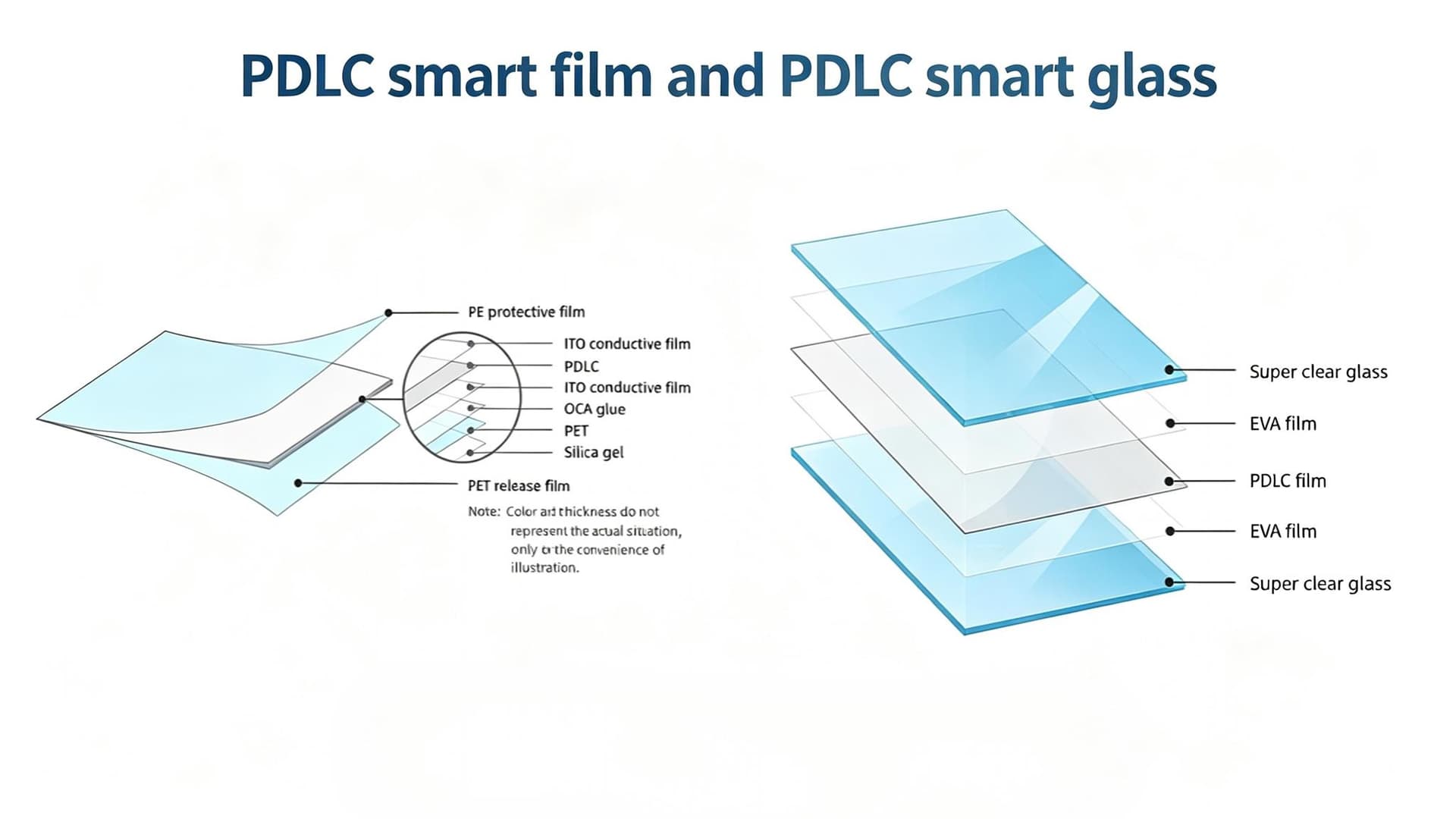
PDLC smart film is the roll of material that contains the liquid crystal layer, the ITO coatings, and the adhesive. It is the raw switchable element. In a roll format, you can apply it to existing glass (self-adhesive version) or send it to a glass laminator who sandwiches it between two panes.
Smart glass is the finished architectural panel. The PDLC film has already been laminated between two sheets of glass at the factory, typically with a PVB or EVA interlayer. What arrives on site is a complete glass unit with the film built in, ready for a glazier to hang.
So when people compare PDLC film and smart glass, they are really asking: do I specify the film and have it laminated or applied locally, or do I specify the finished glass panel from a manufacturer?
Side-by-Side Technical Comparison
| Parameter | PDLC Film (Self-Adhesive) | Pre-Laminated Smart Glass |
|---|---|---|
| Switching speed | <0.5s | <0.5s |
| Light transmission (ON) | 88-90% | 85-88% (glass reduces slightly) |
| Haze (ON) | <2% | <2.5% |
| Opacity (OFF) | 95%+ | 95%+ |
| Operating voltage | 48-65V AC | 48-65V AC |
| Power draw | 4-6 W/m² | 4-6 W/m² |
| Max panel width | 1.8m per roll | 2.1m (factory lamination) |
| Sound insulation | Minimal (single surface) | 20-30 dB reduction (laminated structure) |
| Safety rating | Depends on existing glass | Meets building safety codes |
| UV blocking | 99% | 99%+ (interlayer adds protection) |
| Moisture resistance | Edge sealing required | Fully sealed, superior |
| Reusability | Can be removed | Cannot be repositioned |
Optical Performance Differences
The core PDLC chemistry is identical in both formats, so the switching behavior is the same. However, the laminated glass path introduces two subtle optical differences.
First, light transmission drops by 2 to 3 percentage points in laminated smart glass because the light passes through two additional glass surfaces and the PVB interlayer. For most projects this is imperceptible, but in spaces where maximum daylight is critical, the self-adhesive film on existing glass has a slight edge.
Second, the laminated structure can introduce minor optical distortion if the lamination process is not tightly controlled. Quality laminators use autoclave processing to eliminate air bubbles and ensure optical clarity. Low-quality lamination can result in a slightly wavy appearance, especially at oblique viewing angles.
Structural and Safety Performance
This is where the two products diverge most significantly.
Pre-laminated smart glass is a structural glazing unit. It meets tempered or laminated safety requirements, performs as an exterior surface, and provides much better sound insulation because of the multi-layer glass-plus-film-plus-glass structure. The PVB interlayer also holds shattered glass in place, preventing injury.
Self-adhesive film applied to existing glass does not change the structural properties of the glass. If the existing glass is not tempered or laminated, adding PDLC film does not make it safety glass. For exterior applications or areas requiring safety glazing, the existing glass must already meet code, or you must use laminated smart glass.
Durability and Environmental Resistance
Laminated smart glass has the edge in durability. The PDLC film is fully encapsulated between two glass panes, protecting it from moisture, UV, and mechanical damage. Edge sealing is handled at the factory under controlled conditions.
Self-adhesive film is applied in the field, and its durability depends heavily on installation quality. The edges must be sealed with pH-neutral silicone to prevent moisture ingress. In high-humidity environments (bathrooms, pool areas), improperly sealed self-adhesive film can develop edge delamination over time.
Both formats use the same PDLC emulsion and have the same rated lifespan of over 50,000 switching hours. The difference is in how well the film is protected from the environment.
Installation Complexity
Self-adhesive film installation is a surface application process. The glass must be thoroughly cleaned, the film applied with soapy water as a lubricant, and bubbles squeegeed out. The bus bars are then connected to the transformer. A skilled installer can complete a typical office partition in a few hours.
Laminated smart glass installation is standard glazing work. The panel arrives ready to hang, and a glazier installs it like any other glass unit. The only additional work is connecting the transformer and switch gear. There is no field lamination risk and no installer markup on a delicate surface.
Test Conditions for Comparison
When evaluating samples from different suppliers, test under consistent conditions:
Which Format Fits Your Project
After years of producing both formats, the rule of thumb is straightforward:
- Retrofit project with existing glass? Choose self-adhesive PDLC film. Apply it to the inside of existing glass. Fast, cost-effective, and proven.
- New construction or exterior glazing? Choose pre-laminated smart glass. It is a structural product and will outperform a field-applied film for decades.
- Large project over 100m²? Talk to the coating facility directly. Both formats improve in per-square-meter consistency at volume, and a factory can help you optimize the mix.
As a PDLC film and smart glass producer with our own lamination line, AYSENT produces both formats in-house. For projects requiring non-standard sizes or shapes, our custom smart film guide covers the feasible limits.
Frequently Asked Questions
What is the difference between PDLC film and smart glass?
Which is more cost-effective: PDLC film or smart glass?
Can PDLC film be retrofitted to existing windows?
Do both PDLC film and smart glass require power?
Which option is better for retrofit projects?
Ready for Your Project?
Get free samples and a custom quote from AYSENT, your trusted PDLC smart film manufacturer.
Request a Free Quote