Frosted Is Not Invisible
Frosted glass is easy to trust. When a panel switches from clear to a milky white and the details on the other side disappear, the natural conclusion is that the room is now fully private. That conclusion is close enough for everyday conversation but not precise enough for specification, and the gap between the two is the source of a great many disappointed expectations after handover.
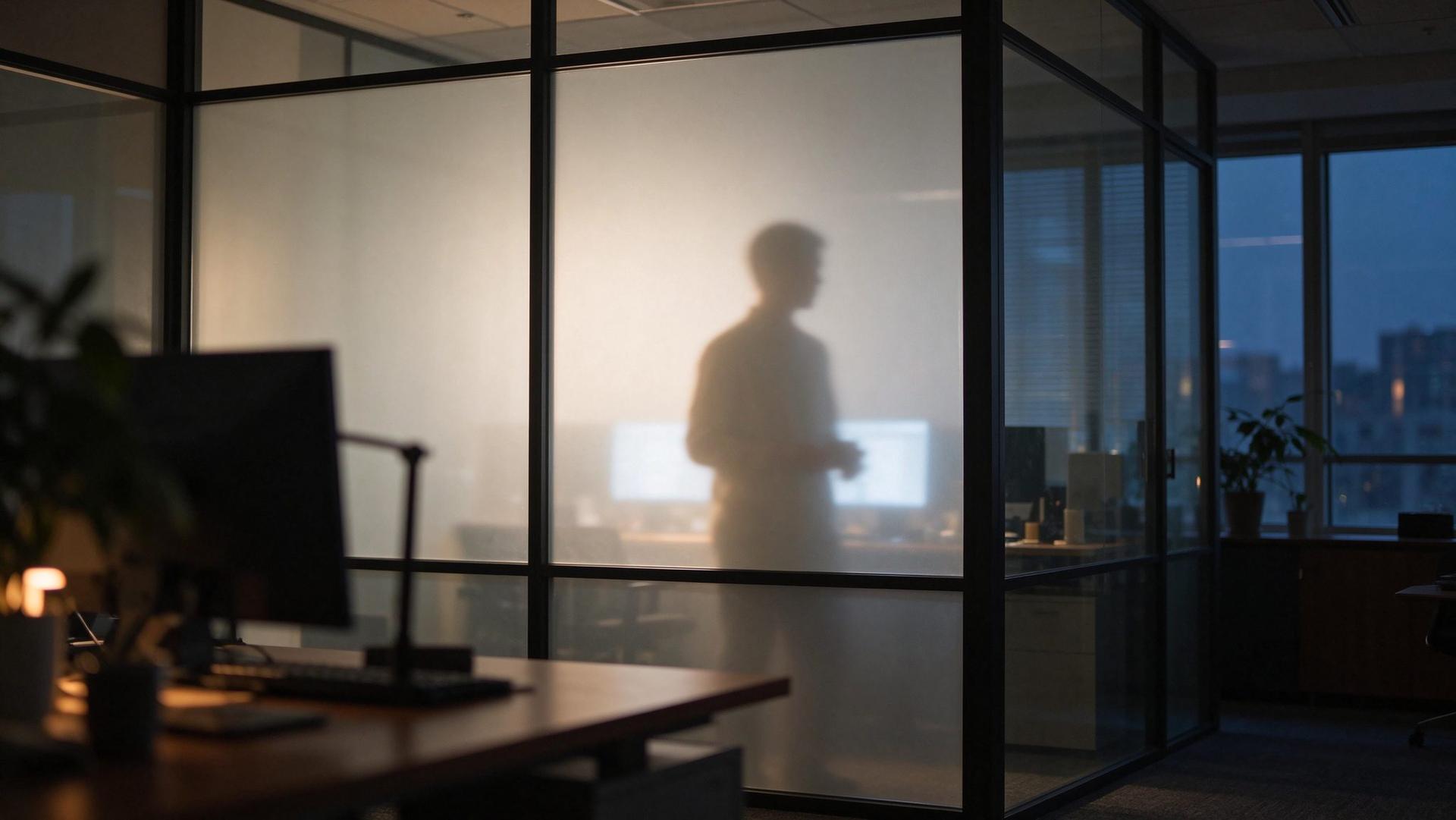
The frosted state removes detail. It does not remove presence. You may no longer be able to read a face, identify a document or follow a conversation, but you can still often tell that a person is there, whether they are standing or sitting, and whether one or several people are moving behind the glass. PDLC film privacy is therefore better understood as a reduction in clarity than as a wall.
This matters most in projects where privacy is a hard requirement rather than a comfort feature. If a partition is expected to conceal the fact that a room is occupied, or to protect a sensitive space from an observer standing close to the glass at night, the frosted state alone may not meet that requirement. The goal of this article is to set out exactly what the film does to light, what an observer can and cannot infer, and how to verify the result on your own project before committing to an order.
How the Film Changes Light: Scattering, Not Blocking
Two Different Ways to Intercept Light
When the power is off, the liquid crystal molecules inside the film lose their aligned order and point in random directions. Light entering the film strikes these disordered molecules and is scattered, sending rays in many directions rather than letting them travel straight through. The image carried by that light is broken apart, which is what produces the frosted appearance.
The critical word is scattered, not absorbed. An absorbing material captures light and converts it into something else, so little energy leaves the far side. A scattering material redirects the same light but allows much of it to continue passing through. PDLC film is a scattering device. In the frosted state a substantial amount of daylight still crosses the panel; it simply arrives without a coherent image.
Why This Distinction Matters
Because the light is redirected rather than removed, the room behind the film stays bright. This is one of the practical advantages of the product: a frosted meeting room does not become a dark cupboard, and the glass continues to distribute daylight deep into a floor plan. But the same property means the film cannot behave like a solid wall or a drawn curtain, both of which rely on blocking rather than redistribution.
It is worth separating this optical question from the thermal one. How much solar energy a panel transmits, and how that affects heat gain and glare, is a different axis of performance covered in our thermal performance article. Visibility and energy are related but not interchangeable, and a film that performs well on one axis should not be assumed to solve the other.
Silhouettes: What Distance and Lighting Reveal
What an Observer Can Actually Infer
Behind a frosted panel, the information that survives is low-resolution but real. An observer can often make out the general outline of a person, the difference between a standing and a seated figure, broad gestures and movement, and the approximate number of people in the room. What is lost is anything that depends on fine detail: facial expression, text, the contents of a screen, and subtle body language.
The Role of Viewing Distance
Distance changes the result in both directions, and it is worth understanding the logic rather than relying on a fixed rule. Pressed close to the glass, an observer's eye receives light from a very small area of the film, and the surface can feel more uniform. Moving back, the eye takes in a wider area and the larger pattern of light and shadow becomes easier to read as a shape. There is no single point at which a figure disappears, because the outcome also depends on lighting, the film's construction and the contrast behind it. This is why any reliable assessment has to be made from the actual viewing distance the project allows, rather than from a general number.
The Role of Brightness Contrast
The single biggest influence on what can be seen is the difference in brightness between the two sides. A figure that is brighter than its background reads as a lighter shape against the frosted surface; a figure in front of a bright background can read as a darker one. The stronger the contrast, the more clearly the outline is presented. When lighting on both sides is similar and diffuse, contrast is low and the film does its best work. When one side is strongly lit and the other is dark, the balance shifts and silhouettes become easier to read.
The Night-Time Problem
Why the Contrast Reverses
This is the most important section for anyone specifying exterior-facing or street-level glass. During the day, a lit interior is often similar in brightness to the outdoors, or darker than it, so the contrast across the glass is limited. At night the situation inverts. The exterior becomes dark while the interior remains lit, and the panel now has a bright space on one side and a dark one on the other.
Under those conditions the frosted glass behaves less like a wall and more like a softly lit screen. The light crossing the film carries the shapes of whatever is between the observer and the brighter background, and silhouettes that were hard to read in daylight become noticeably clearer. This is not a defect or a sign of a low-quality product; it is the predictable optical result of a scattering material placed across a strong brightness difference. Switchable film at night does not stop transmitting light, because stopping light was never its mechanism.
Design-Level Ways to Manage It
The night effect cannot be eliminated by changing the film alone, but it can be managed through design decisions that reduce contrast and avoid placing bright sources directly behind the glass.
- Lighting zones. Rather than flooding the whole room with uniform brightness, use layered lighting and keep the area immediately behind the glass at a lower level.
- Positioning. Arrange desks, seating and circulation so people do not stand or move directly between a strong light source and the panel.
- Avoiding backlight. Do not place bright fixtures facing the glass, and use directional fittings that keep light off the panel.
- Secondary cover. Where night-time concealment is a genuine requirement, a separate layer such as a blind or curtain can be drawn only when needed, combining daylight openness with night privacy.
The right combination depends on the space and the intensity of the requirement, and it is more productive to plan for it at the design stage than to discover it after the room is occupied.
Screens and Bright Objects Behind the Film
Why Small Bright Sources Survive the Frost
Not every object behind frosted film is equally well hidden. Large, evenly lit surfaces diffuse into the milky background and lose their shape. Small, intensely bright sources behave differently. A monitor, a lightbox, a projected image or an illuminated sign produces a region far brighter than its surroundings, and that local brightness still passes through the scattering layer.
What reaches the observer is not usually a readable image of the screen's contents, but a recognisable bright patch with a shape and position that correspond to the object. A person on the far side can tell that a display is on, where it sits and roughly how large it is, even when the content itself cannot be read.
What This Means for Layout
This is relevant in meeting rooms and control spaces where displays sit close to glazed partitions. If the location of a screen, an indicator panel or a lit sign is itself sensitive, it should not be assumed that the frosted state will conceal it. The practical responses are to reposition the object away from the glass, to reduce its brightness or switch it off when the room is not in use, or to treat the glass as a surface that reveals the presence of light sources rather than their detail. As with silhouettes, the effect is governed by contrast: the brighter the object relative to its background, the more clearly it shows through.
Why Blackout Needs a Different Material
A Diffuser Is Not a Shade
Some requirements are not really about privacy at all but about darkness. A presentation room, a home cinema, a sleeping area or a light-sensitive space may need the room to be genuinely dark, which means light has to be blocked rather than redistributed. This is the core of the pdlc film vs blackout question.
PDLC film cannot deliver that. Because it scatters light rather than absorbing it, a frosted panel keeps the room bright and continues to transmit a large share of the daylight reaching it. Switching the film changes clarity, not the overall amount of light in the room. Treating it as a blackout product is a category error, and one that is only discovered when the lights are turned down and the room refuses to darken.
Buyers who ask whether PDLC film is one-way are also thinking of a different product. The film has no reflective mirror layer and does not produce a one-way effect; it scatters light in the same way regardless of which side is brighter, so it should not be treated as a one-way privacy material.
What Genuine Blackout Requires
True light exclusion calls for an opaque or strongly absorbing layer. Heavy blackout curtains and blinds, opaque solid panels and interlayers engineered to absorb light are built for this purpose and work by a mechanism that PDLC does not use. The two can be combined in a single space: the smart film provides on-demand clarity and daytime privacy while a separate opaque layer is used when darkness is the priority. Specifying them as complementary rather than interchangeable avoids the disappointment of expecting one product to do both jobs.
Where Privacy Holds Up, and Where It Does Not
The Requirement Defines the Result
There is no single answer to whether the frosted state provides enough privacy, because enough depends entirely on what the space is meant to protect. The smart film privacy limits are not a fixed line; they move with the observer's distance, the lighting and the sensitivity of what is behind the glass. It helps to think through the common cases.
Meeting and Conference Rooms
For most office meeting rooms, the film performs well. The requirement is usually to prevent passers-by reading documents, screens and faces during the day, and the frosted state does that effectively while keeping the room bright. Night use and close-range observers are the points to check, especially for ground-floor rooms facing the street.
Washrooms and Changing Areas
These spaces carry a stronger privacy expectation and are often judged against the standard of a solid wall. Even though fine detail is hidden, the possibility of reading a silhouette can feel unacceptable here. Careful lighting that keeps contrast low and avoids backlighting is essential, and many projects pair the film with a secondary layer rather than relying on it alone.
Street-Facing Retail and Showrooms
Retail glass is typically viewed from close range and at night, precisely the conditions under which silhouettes are most visible. The frosted state can be valuable as a diffusing surface and for projection, but it should not be specified as a way to conceal activity in a lit shop after dark.
Residential Bedrooms
At night, a bedroom faces the same contrast reversal as any exterior glass, and occupants often expect the level of concealment a curtain provides. If night-time privacy is the priority, the film should be treated as a daylight and design feature rather than a substitute for window coverings.
These are judgments rather than fixed verdicts, and the same logic is explored across the typical applications for switchable glass in more detail.
Specifying and Verifying Privacy Before You Order
Why a Sample Test Is the Only Reliable Check
Specifications and marketing descriptions cannot tell you how the film will look in your specific room, because the result depends on conditions that are unique to each project: the lighting, the viewing distance, the orientation of the glass and what sits behind it. The only reliable way to assess PDLC film privacy is to test a physical sample under the real conditions the installation will face.
A Practical Verification Routine
- Obtain a representative sample. Use a sample of the actual film and construction being proposed, rather than a generic showroom piece.
- Test in the real space. Place the sample where the glass will go and view it from the positions and distances people will actually use.
- Check both lighting conditions. Look at it in daylight and again after dark with the interior lights on, because the two produce different results.
- Use a real person. Have someone stand, sit and move behind the sample rather than judging an empty panel, since silhouettes are the central question.
- Check bright objects. Switch on a monitor or place a bright light behind the film to see how small light sources appear.
- Involve the decision-makers. The people responsible for accepting the privacy outcome should see the test themselves rather than rely on a second-hand description.
This verification also fits naturally into the wider specification process. Our PDLC film selection guide covers how to match the film to project conditions, and the sample test is the privacy-specific step within that process.
Every project balances openness, daylight and privacy differently, and the honest approach is to establish what the film will and will not conceal on your site rather than rely on a general claim. If you are planning a partition, facade or interior glazing project and would like a privacy assessment tailored to the space, our technical support team can review the layout and lighting and advise on a realistic specification. Get in touch with your project details and we will help you evaluate the result before you order.
Frequently Asked Questions
Does PDLC film provide 100% privacy?
Can people see through PDLC film at night?
Is PDLC film the same as one-way mirror film?
Can PDLC film replace blinds or blackout curtains?
Ready for Your Project?
Get free samples and a custom quote from AYSENT, your trusted PDLC smart film manufacturer.
Request a Free Quote